Revised New General
Catalogue and Index Catalogue
Dr Wolfgang Steinicke, FRAS
8 February 2026
To my wife Gisela
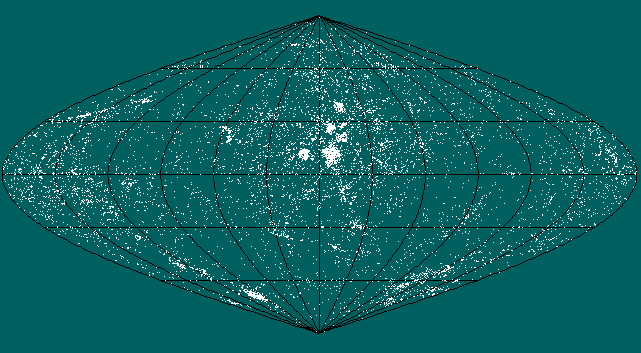
Plot of all NGC and IC objects (equatorial
system). The "clusters" seen are partly due to selection effects (see
text)
Important note: Any non-commercial use of my data is free! If a commercial use is planned, please contact me! Please inform the author Dr. Wolfgang Steinicke (also in case of non-commercial use, e.g. in a free software). In any case, a proper acknowledgment of the source, including an answer-back to the author is necessary. These data are part of a scientific project and subject to copyright!
Preface to
the current version
There are
new columns for redshift(z), distance (derived from z)
and metric distance. All data are arranged in a single line. The amount of
objects with status "not found" remains constant (2.3%).
The Revised
NGC/IC gives the physical and identification data for each object.
Additionally, the Historic NGC/IC is available, presenting the
historical data for each object: discoverers, discovery dates, instruments and
references in the original NGC and IC (see "NGC/IC" button). It is
part of my comprehensive study about the history of the NGC. The results were
published in August 2010 by Cambridge University Press: Observing
and Cataloguing Nebulae and Star Clusters - From Herschel to Dreyer's New
General Catalogue (see "Publications" button).
Unfortunally,
I was forced in 2006 to remove all my data from the NGC/IC Project website.
This is due to a conflict with the former webmaster Bob Erdman, who eventually
has terminated his activities for the project in 2009. His "Historically
Corrected NGC", first presented on the project website in April 2006, is a
mere copy of my Historic NGC (Jan. 2006) which is
evident by an overwhelming amount of facts. The necessary acknowledgment is
still missing. Hopefully, a totally revised NGC/IC Project webseite will be
launched this year. This offers a chance for a return of my NGC/IC data!
The data
of my Revised New General Catalogue and Index Catalogue
are used by Mathematica, TheSky, Guide, SkyMapPro, Starry Night,
Eye&Telescope, the SAC database and the database of the Losmandy mounting.
Wolfgang
Steinicke, Umkirch
Table of
contents
3 Content and structure of the catalogue
3.2 NGC/IC-numbers, extension letters and components
3.4 Coordinates and constellations
3.5 Magnitudes, sizes, position angle and type
3.6 Identifications and remarks
The present work contains
all objetcs listed in Dreyer's [12] New General Catalogue (NGC),
published in 1888 and its two supplements, the Index Catalogue, published
in 1895 (IC I), and the Second Index Catalogue, published in 1908 (IC
II). The NGC contains 7840 nonstellar objects, the IC I and IC II add another
1520 and 3866 objects, respectively. For a comprehesive history of the NGC, see
my latest book.
The historic catalogues
collect nonstellar objects, discovered by different observers over the
centuries. The history of the NGC/IC is reviewed in detail in my recent book
"Observing and Cataloguing of Nebulae and Star Clusters". It
is based on my "Historic NGC/IC" datasets. The NGC and the IC I
contain all objects found visually up to 1895, regardless of their
magnitudes, sizes or various types. This naturally implies a great
inhomogeneity. Modern catalogues, e.g. Nilson's UGC [20], are homogenous
samples based on precise definitions. Nilson gives also a short survey of the
history of catalogues of galaxies (UGC, p. 449). The IC II is of even greater
inhomogeneity. The main reason is the advent of photography at the beginning of
the century. Beside new nonstellar objects found visually up to 1908, Dreyer
included all objects found on plates, taken e.g. by Max Wolf with the
Bruce-Astrograph at Heidelberg Observatory. There are crowded
"photographic areas" in the IC II, rivaling with real clusters
(Virgo, Coma, Fornax; see front cover). A considerable amount of this faint objects (down to 18 mag) are not listed in any
modern catalogue, being unverified for a long time.
Dreyer was aware, that his
data contain many errors. He published lists of corrections. Later Reinmuth
[25], Carlson [3] and others made corrections. Modern revisions of Dreyer's
catalogues were published by Sulentic and Tifft (1977) and by Sinnott (1988).
The Revised New General Catalogue (RNGC) by Sulentic and Tifft [29] is
an attempt to update the NGC, listing all objects with 1975 positions. Sinnott
[27] was the first (exactly 100 years) after Dreyer, who lists the complete
NGC/IC with all 13226 objects. His NGC 2000.0 gives positions for the
equinox 2000.
My own work starts around
1981 with the compilation of the Revised Index Catalogue, a rather
criminalistic work, done by scanning a printed version of Dixon's monumental
"Master List" [11]. This sounds rather unscientific, but a digital
approach was out of reach at that time. It soon becomes clear that there is a large number of unverified objects and many
misidentifications in the literature. A considerable number of IC-objects are
identical to existing NGC-objects, and there are IC-objects which appear twice
(or even multiple) in the IC. The confusion is due to the fact that the NGC and
both IC parts are inhomogenous samples, covering the whole sky independently
(sorted by right ascension).
During the revision of the
IC, it becomes evident that the same work has to be done for the 7840
NGC-objects. The confusion found in the IC is also present in the NGC and there
are disturbing interferences between both catalogues.
Beside the contributions
form the NGC/IC Project, which is desribed in the next chapter, identifications
of NGC/IC-objects are based on various sources (described in chapter 3), charts
and photos. All objects were visually inspected with RealSky [23] or the
Digital Sky Survey [24]. For galaxies the major datasets were consulted, e.g.
PGC/LEDA [21], UGC [20], MCG [33], CGCG [34], RC3 [10] and NED, the Nasa/IPAC
Extragalactic Database and the new DSFG [8]. A number of bright NGC- and
IC-galaxies is illustrated in the Carnegie Atlas of Galaxies by Sandage
and Bedke [26], which includes all objects listed in the Shapley-Ames
catalogue.
The result presented here
is not comparable to the work of Sulentic & Tifft or Sinnott, which
often failed to clear a confusing case or even totally missed it. Both datasets
contain may errors. Examples are given in Steve
Gottlieb's Corretions to the RNGC [14] and in Fig. 1. Another one is IC
4274: the NGC 2000.0 gives Decl = -25°, but this must be Decl = -65°,
leading to the identity IC 4274 = NGC 5189.
My catalogue contains all
available data and cross identifications. Missing or inaccurate data for
galaxies (magnitude, size, position angle) were completed. Chapter 3 describes
the content and structure of the catalogue and explains the columns (fields).
Chapter 4 lists the literature, and the chapters 5 and 6 are the main parts:
the data.
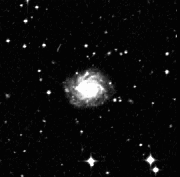
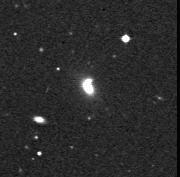
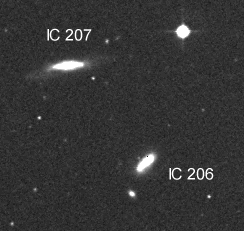
Fig. 1 - Examples of identified objects.
|
|
NGC 6993 -
The object is declared as "not found" in the RNGC and so the type is
"-" in Sinnott's book. But actually NGC 6993 is a bright Sc galaxy
(13.8 mag) in Capricornus. |
|
|
IC 252 - Sinnott does not identify the
object (type "blank"), but actually this is a pretty bright double
galaxy with a total magnitude of 15.5 mag, located in Cetus. The object is
not listed in the PGC or in any other catalogue! The south following
lenticular galaxy is "anonymous". |
|
|
IC 206/207 -
Sinnott does not identify both objects (type "blank"). Actually
this is a rather "prominent" pair of bright galaxies in Cetus with
magnitudes 13.1 mag and 12.8 mag. The (known)
identifications are IC 206 = MCG -1-6-53 = PGC 8238 and IC 207 = MCG -1-6-54
= PGC 8251. |
|
|
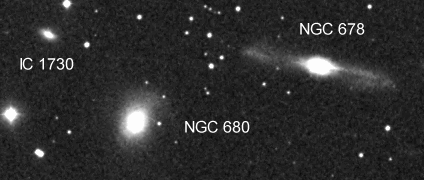
NGC 678 - This case is based on an
identification problem mentioned in the Carnegie Atlas of Galaxies [26],
panel 152. The coordinates of the edge-on galaxy named A0147+21 were
incorrect, so this interesting object (noted by Allan Sandage) could not be
found again. I identified it with NGC 678 = UGC 1280, a bright galaxy (13.3
mag) in Aries, accompanied by NGC 680 and IC 1730. |
The aim of the NGC/IC
project, headed by Dr. Harold G. Corwin jr. (Pasadena/USA), is to clean the
historical NGC and IC. All investigations start from the historical data, e.g.
the observer's publifications. Dreyer's data are often not consistent. There
are puzzles (see e.g. [7], [31]), which are hard to solve, or will never be
solved, because the hictorical data are too poor (e.g. the IC 919 group in Ursa
Major in the center of galaxy cluster Abell 1783). An example of a solved
problem (by Harold Corwin) is NGC 3518, which position was found to be in error
by 1h in right ascension, leading to the final identity NGC 3518 = NGC 3110 =
NGC 3122.
The present work has been
done as part of the project, to get accurate positions and to fill large gaps
in the data. Up to now, core team members have presented major contributions to
the problem of the NGC/IC identities. Most famous are Malcolm Thomson's Identity
Survey of IC Galaxies [31], Harold Corwin's Precise Position List
[6] and NGC/IC Puzzle Solutions [7], and Steve Gottlieb's Corrections
to the RNGC [14]. Over the last years I checked all objects. Many errors
were found by me and others. E.g. IC 3400, listed as a 16.2 mag galaxy, is
actually a star of 10 mag! It is often usefull to
inspect critical cases by visual observations, as Steve Gottlieb does to
simulate the historical situation. In spite of using digital tools like CCD,
Internet and CD-ROM in astronomy, the value of visual observing is still high -
particularly for the NGC/IC cleaning process! The DSS is often helpfull, but it
can cause wrong results. Due to the fact, that the
photographic and visual magnitudes of nonstellar objects differ and also that
the optical image of diffuse objects looks quite different through a telescope
or on a photo.
Although the team member's approaches
do not totally agree, most identifications are
confirmed within the group. But some still vary and this supports many valuable
discussions, leading (perhaps) to a final result!
3 Content and structure of the catalogues
The present work consists
of two parts: the Revised New General Catalogue, listing all 7840
NGC-objects and the Revised Index Catalogue, listing all 5386 IC-objects
(the first and final objects are shown in Fig. 2 and 3).
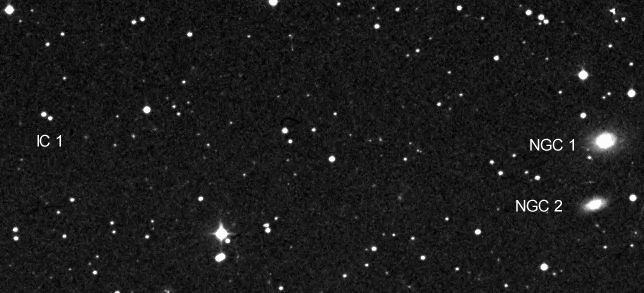
Fig. 2 - The
first entries are located in Pegasus: the „classical" pair of
galaxies NGC 1 / NGC 2, and IC 1, a pair of stars.
Both parts use the same
arrangement of columns (fields). The catalogue fields are listed in Tab. 1,
discussed in detail in the following sections. Due to the confusion in
the original NGC/IC it should be better to talk about entries (or
identities), rather than objects. Many entries in the NGC/IC cannot be
found or are non-existent,
the classical example is NGC 7088, called "Baxendell's unphotographable
nebula". The number of existing objects in both catalogues is
smaler than the number of entries. A fact which is often ignored by modern
computer-telescope databases, used to punch-in the desired object for automatic
positioning. In the case of NGC 7088 you will see a blank field, in other cases
(see below) you will run into confusion.
Tab. 1 -
Explanation of the catalogue
columns
|
Columne |
Explanation |
|
N |
Catalogue N = N (NGC) or N = I
(IC) |
|
NI |
catalogue number . Some objects have an extension letter (A,B,C,...). |
|
A |
Extension letter: A, B, C... |
|
C |
Components. If two or more different objects use the same
NGC- or IC-number, these are numbered as components (1,2,3,...).
This is also applied for objects associated with the main entry. |
|
D |
Dreyer Object. A * marks, that this is the object
which is ment in Dreyer's catalogue (many objects with extension letters are
not in the original NGC/IC). |
|
S |
Status. Status of the identification (see Tab. 2) |
|
P |
Precision. Flag for high precision position |
|
CON |
Constellation |
|
RH, RM, RS |
Right ascension. Equinox J2000.0 |
|
V, DG, DM, DS |
Declination. Equinox J2000.0 |
|
Bmag |
Photographic (blue) magnitude |
|
Vmag |
Visual magnitude |
|
B-V |
Difference of visual and blue
magnitude |
|
SB |
Surface brightness (mag/arcmin2) |
|
|
Larger/smaller diameter ('). If only one value (a) is given, this refers to the maximum size. |
|
PA |
Position angle (°). The position angle is only relevant for
galaxies, and given if possible. |
|
Type |
Type of object |
|
z |
Redshift (from NED or LEDA) |
|
D(z) |
Distance derived from z
in Mpc, using |
|
|
Metric distance: for galaxies with S = 1, 6, 7 or 8 in Mpc (from NED); for other types with S = 2, 3, 4, or 5 in kpc |
|
PGC |
PGC-number. Object listed in the Catalog of Principle
Galaxies [22] |
|
ID1 - ID11 |
Identifications; the last
non-empty field contains remarks (if any) |
|
|
|
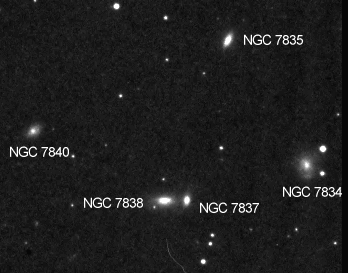
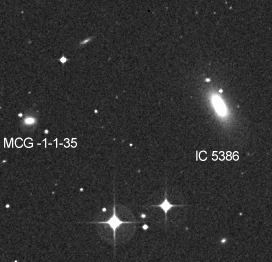
Fig. 3 - The final entries in the
catalogues are located in Pisces: NGC 7840 in a small group of NGC-galaxies
(all found at Malta by Albert Marth), and the galaxy IC 5386, which is
identical to NGC 7832 (seen by Swift and Howe and discovered earlier by William
Herschel).
3.2 NGC/IC-numbers, extension letters and components
The catalogues are sorted
by NGC- and IC-number respectively (taking into account the extension letters).
The NGC2000.0 sorts the objects by right ascension, but this is rather awkward,
because the precision of the coordinates listed there is rather poor.
There is
a considerable number of double/multiple identifications: one object has
different NGC- or IC-numbers (or both). Examples are the southern galaxy IC
2624 = NGC 3497 = NGC 3525 = NGC 3528 in the constellation Crater or
"Barnard's galaxy" NGC 6822 = IC 4895. All these internal
identifications are given in the catalogues.
Even more
trouble results from the use of extension letters (e.g. IC 3481A), which were
introduced during the last decades to denote new objects in the vincinity, not
listed in the original catalogues. In a few cases an original entry is split into
two or more names with different extensions, such as NGC 61 in Cetus, which is
now NGC 61A and NGC 61B (both are galaxies), or the galaxies in
Seyfert's Sextett (NGC 6027A to NGC 6027E = VV 115; the diffuse extension
north-west of NGC 6027B was thought by Seyfert to be a sixth galaxy).
In some cases the original
name is retained, but extension letters are added to denote fainter objects in
the vicinity, e.g. NGC 3250, a galaxy in Antila which is surrounded by 5
companions named NGC 3250A thru NGC 3250E. In one case the extension letter
denotes a direction: the "S" in NGC 2175S means "south",
denoting a small open cluster east (!) of the emission nebula NGC 2175.
The field C is used to
distinguish individual components. Double or multiple systems are split into
different components, all with individual data. If extension letters are
present, two or more entries are possible, e.g. NGC 78 with C=1 (=NGC 78A), NGC
78 with C=2 (=NGC 78B) and the entries for NGC 78A and NGC 78B itself.
The included entries with
extension letters and different components rise the
number of objects, while the internal identifications lowers it. The net number
(which is by now impossible to calculate) of "real" objects in both
catalogues - not regarding the question of existence here - is considerable
lower than 13226 (the sum of the original NGC- and IC-entries). The total number of
entries in the Revised NGC/ IC is 13957 (see Tab. 2).
Not all objects in the
catalogue are in Deyer's original NGC/IC. To assign the identity a * is used in
column D.
The field S describes the
status of identification, as explained in Tab. 2. Objects with S=1 to 5 are the very NGC/IC objects (sum for NGC: 7051 =
89.9 %, for IC:
4140 = 76.9 %).
Tab. 2 -
Explanation of the field S and number of entries in the Revised NGC and
IC (13226 objects from original catalogue + 731 added objects = 13957).
|
S |
Explanation |
NGC |
% |
Add |
IC |
% |
Add |
|
1 |
Galaxy |
6022 |
76.8 |
465 |
3972 |
73.7 |
149 |
|
2 |
Galactic nebula, Supernova remnant |
147 |
1.9 |
|
86 |
1.6 |
4 |
|
3 |
Planetary nebula |
94 |
1.2 |
|
36 |
0.7 |
|
|
4 |
Open cluster |
673 |
8.6 |
3 |
38 |
0.7 |
|
|
5 |
Globular cluster |
115 |
1.5 |
|
8 |
0.1 |
|
|
6 |
Part of other object (e.g. bright
HII region of a galaxy) |
30 |
0.4 |
1 |
23 |
0.4 |
|
|
7 |
Object already in the NGC- or IC |
261 |
3.3 |
78 |
76 |
1.4 |
5 |
|
8 |
IC-object already in the NGC |
|
|
24 |
268 |
5.0 |
2 |
|
9 |
Star(s) |
404 |
5.1 |
|
672 |
12.5 |
|
|
10 |
Not found |
94 |
1.2 |
|
207 |
3.8 |
|
|
|
Sum |
7840 |
|
571 |
5386 |
|
160 |
Objects with S=6 are parts
(often bright HII regions) of a large galaxy. Examples are NGC 588, NGC 592,
NGC 595 and NGC 604, which are HII regions in M 33 = NGC 598 or IC 3550, 3551,
3552, 3555 and 3563, which are parts of NGC 4559. One could assign these
objects a status S=7, which I did not.
If an NGC (or IC) object
appears twice or more in the NGC (or IC), all entries with higher NGC (or IC)
number carry a status S=7, e.g. NGC 34 (S=7), which is the same as NGC 17
(S=1). All data for these entries are equal. Naturally the "object",
e.g. NGC/IC-Number, discovered later, gets the "7". The order for NGC
entries is based on the "Historic NGC", presenting the discovery
dates.
There is a curious example
in the IC, which I call the "Swift-Barnard battle" near Algol: the
objects involved are IC 290, 292, 293, 294, 295 and 296, all observed by Swift,
and IC 1883, 1884, 1887, 1888 and 1889, all observed by Barnard. Following
Corwin [6], the identities are: IC 290 = IC 1884, IC 292 = IC 1887, IC 293 = IC
1888 and IC 294 = IC 296 = IC 1889 which might be also identical to IC 295,
further IC 1883 = NGC 1212 (for different view see [31]).
Status S=8 is given for
crossover identities bewteen NGC and IC; in the last example: IC 1883 (S=8) and
NGC 1212 (S=1). The reverse case is only applied, if the NGC object does not
belong to the original set, e.g. NGC 191A (S=8) is identical to IC 1563 (S=1).
Entries with S=9 are single
stars, pairs (e.g. the famous pair of stars IC 1 (Fig. 2) in Pegasus; see Fig.
2), trios, groups (asterisms) or clouds of stars. For most single stars a
magnitude is given; for the brightest there is a designation (e.g. SAO). Among
the record holders (see Tab. 3) is Alpha CVn = NGC 4530. John Herschel
suspected some nebulosity around it, which does not exist. Fig. 4 shows the
case of the asterism NGC 7005 in Aquarius, discovered by d'Arrest.
Tab. 3 - The brightest stars in the NGC (the record holder in the IC is the 6.5 mag star IC 1851).
|
Object |
Star |
Magnitude (V) |
|
NGC 771 |
50 Cas |
4.0 |
|
NGC 4530 |
ß CVn |
4.3 |
|
NGC 2542 |
19 Pup |
4.7 |
|
NGC 2142 |
3 Mon |
5.0 |
Entries with S=10 are not
found. Tab. 2 shows, that this applies only to
301 cases (2.3%) in the NGC/IC. Calling these
entries "non existent", as the RNGC often does, may be correct. But
in some cases, the object could exists at another
place, due to observing errors or errors in compiling the NGC/IC. IC 5126 (Fig.
4) in Aquarius is an example. Sinnott does not identify this object (type
"blank"). The IC description reads "vF, vS, R, between 2 st
14", which assigns a very faint, very small, round object located between
2 stars of 14 mag. The position is marked with a "+", but there is no
object, it exists nearly 1° south.
It is also incorrect to
declare the nearest anonymous object as the missing one. As already mentioned,
critical cases - also those already "fixed" in the literature -
should be carefully investigated with the help of the historical sources. The
NGC/IC Project is working on all these "puzzles".
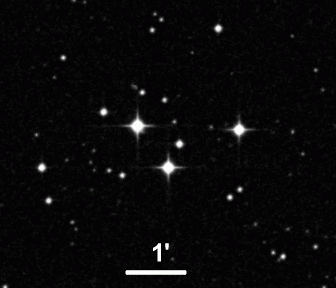 |
|
|
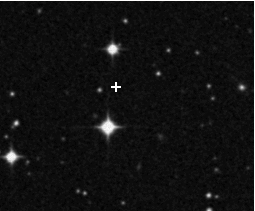
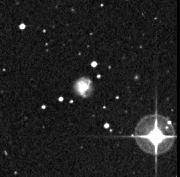
Fig. 4 - From left to right: NGC 7005, an
asterism in Aquarius (s=9; type: *Grp); IC 5126 in Aquarius (at the nominal
position there is no nonstellar object); IC 5126 is a confirmed galaxy at a
different position.
3.4 Coordinates and constellation
The coordinates are given
for the modern equinox 2000.0 (the most northern and southern objects are shown
in Fig. 6). The positions for objects with status S=1,6,7,8,9 or 10 are
determined with RealSky [23] or DSS [24]. Normally the center of brightness or
morphology is used. For large objects (galaxies, star groups or clusters) the
center is not well defined. In case of double stars with comparable brightness
the geometric center is measured, otherwise the position of the brighter
component is given. A total of 12632 accurate positions were measured, flagged
by '1' in the field P. Coordinates for globular clusters are from Harris [15].
For planetary nebulae precise coordinates were determined by Brian Skiff [28].
Coordinates for "diffuse" objects like gaseous nebulae or open
clusters are adapted from various sources.
With RealSky positions can
be measured to an accuracy of 1-2". The result was compared with the Lick
Northern Proper Motion Survey Galaxy Calalogue (NPM1G) [18], the new list of
MCG positions from Corwin [5], with the GSC and the ESO data [19]. The
comparison with the GSC was made by Steve Gottlieb, finding a systematic shift
of 2.5" towards the south (Fig. 5 left), due to an internal
"problem" of the RealSky software. This shift was corrected.
The comparision with the
ESO/Uppsala positions is the first global check of Laubert's measurements in
the late 70's (Fig. 5 right). The average values of the absolute differences
are 3.8" in Rect and 3.5" in Decl. The center of the cloud is at (+0.2",-2.0"),
the shift is also present here! It is also noticable, but with a lower value of
1.5" in the differences RealSky-NPM1G. It seems to me, that the positions
determined with the Digital Sky Survey are better.
|
|
|
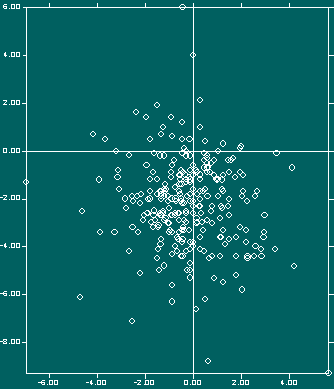
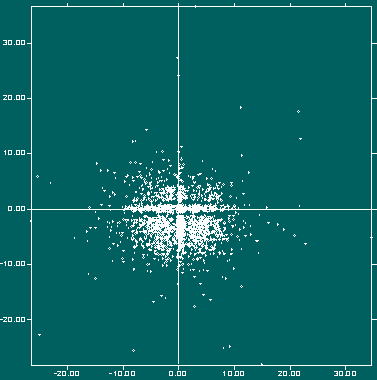
Fig. 5 - Coordinate differences in arcsec
between this catalogue (RealSky measurements) and the GSC (left) and
ESO/Uppsala (right).
The constellation is
calculated from the borders given by the IAU. Most of the 7840 NGC objects are
located in Virgo (678), only 4 NGCs are in Chamaeleon
and Equuleus. Most of the 5386 IC objects are located in Coma Berenices (687), no IC is in Circinus and Crux. The following table shows
the numbers for all constellations.
|
Con |
NGC |
IC |
Sum |
|
Con |
NGC |
IC |
Sum |
|
AND |
154 |
46 |
200 |
|
LAC |
26 |
12 |
38 |
|
ANT |
49 |
43 |
92 |
|
LEO |
385 |
441 |
826 |
|
APS |
8 |
20 |
28 |
|
LEP |
32 |
29 |
61 |
|
AQL |
40 |
8 |
48 |
|
LIB |
57 |
19 |
76 |
|
AQR |
142 |
123 |
265 |
|
LMI |
63 |
49 |
112 |
|
ARA |
16 |
9 |
25 |
|
LUP |
18 |
11 |
29 |
|
ARI |
81 |
66 |
147 |
|
LYN |
100 |
36 |
136 |
|
AUR |
25 |
15 |
40 |
|
LYR |
33 |
5 |
38 |
|
BOO |
264 |
230 |
494 |
|
MEN |
72 |
12 |
84 |
|
CAE |
16 |
7 |
23 |
|
MIC |
11 |
19 |
30 |
|
CAM |
45 |
29 |
74 |
|
MON |
58 |
9 |
67 |
|
CAP |
27 |
30 |
57 |
|
MUS |
6 |
4 |
10 |
|
CAR |
40 |
14 |
54 |
|
NOR |
14 |
2 |
16 |
|
CAS |
41 |
17 |
58 |
|
OCT |
7 |
8 |
15 |
|
CEN |
138 |
60 |
198 |
|
OPH |
42 |
21 |
63 |
|
CEP |
36 |
10 |
46 |
|
ORI |
65 |
29 |
94 |
|
CET |
409 |
240 |
649 |
|
PAV |
49 |
231 |
280 |
|
CHA |
4 |
3 |
7 |
|
PEG |
319 |
114 |
433 |
|
CIR |
5 |
|
5 |
|
PER |
95 |
60 |
155 |
|
CMA |
38 |
8 |
46 |
|
PHE |
40 |
20 |
60 |
|
CMI |
19 |
6 |
25 |
|
PIC |
20 |
1 |
21 |
|
CNC |
117 |
220 |
337 |
|
PSA |
38 |
17 |
55 |
|
COL |
17 |
8 |
25 |
|
PSC |
301 |
172 |
473 |
|
COM |
298 |
687 |
985 |
|
PUP |
57 |
7 |
64 |
|
CRA |
5 |
3 |
8 |
|
PYX |
12 |
1 |
13 |
|
CRB |
37 |
17 |
54 |
|
RET |
11 |
25 |
36 |
|
CRT |
87 |
32 |
119 |
|
SCL |
61 |
36 |
97 |
|
CRU |
8 |
|
8 |
|
SCO |
51 |
15 |
66 |
|
CRV |
35 |
17 |
52 |
|
SCT |
13 |
3 |
16 |
|
CVN |
212 |
278 |
490 |
|
SER |
76 |
73 |
149 |
|
CYG |
70 |
24 |
94 |
|
SEX |
66 |
41 |
107 |
|
DEL |
22 |
7 |
29 |
|
SGE |
6 |
2 |
8 |
|
DOR |
299 |
38 |
337 |
|
SGR |
84 |
41 |
125 |
|
DRA |
301 |
55 |
356 |
|
TAU |
48 |
42 |
90 |
|
EQU |
4 |
11 |
15 |
|
TEL |
28 |
87 |
115 |
|
ERI |
327 |
110 |
437 |
|
TRA |
6 |
4 |
10 |
|
FOR |
67 |
42 |
109 |
|
TRI |
82 |
38 |
120 |
|
GEM |
67 |
47 |
114 |
|
TUC |
62 |
62 |
124 |
|
GRU |
48 |
29 |
77 |
|
UMA |
409 |
101 |
510 |
|
HER |
214 |
96 |
310 |
|
UMI |
36 |
18 |
54 |
|
HOR |
25 |
66 |
91 |
|
VEL |
36 |
5 |
41 |
|
HYA |
227 |
136 |
363 |
|
VIR |
678 |
502 |
1180 |
|
HYI |
11 |
2 |
13 |
|
VOL |
9 |
1 |
10 |
|
IND |
43 |
45 |
88 |
|
VUL |
20 |
6 |
26 |
|
|
|
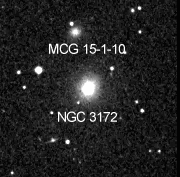
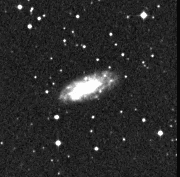
Fig. 6 - The most northern and most
southern entries in the catalogues are both galaxies: NGC 3172 in Ursa Minor
("Polarisima borealis") and NGC 2573 in Octans ("Polarissima
australis").
3.5 Magnitudes, size, position angle and type
The data for magnitudes,
sizes, position angles and types for NGC/IC-objects are incomplete in the
literature. Using RealSky and DSS gaps were filled.
The magnitudes listed in
the field Bmag are photographic (blue), based on plate inspections/measurements
(CGCG, MCG, ESO, DSS and RealSky). The faintest object is shown in Fig. 7. One
new source is the NPM1G [18] which gives precise
positions and magnitudes. In some cases the magnitudes between PGC, UGC and
NPM1G differ by more than 2 mag (the rms-error between PGC and NPM1G is 1.0
mag; mostly the PGC lists the brighter magnitude). In case of a galaxy with
compact core and diffuse halo the difference to NPM1G is comprehensible (due to
the digital plate measuring process), otherwise the reason is unclear. Examples
are IC 983: PGC 12.5 mag, UGC 14.3 mag, NPM1G 14.7 mag or NGC 3074: PGC 13.4
mag, UGC 14.8 mag, NPM1G 16.0 mag.
The magnitudes listed in
the field Vmag are visual. If these - in the case of galaxies - are not given
in the literature (e.g. the RC3 [10]), Vmag is calculated using the type of the
galaxy as described e.g. in the DSFG [8].
The magniude listed in the
field SB is the calculated surface brightness for galaxies (see the RC3 [10] or
the DSFG [8]).
The data for sizes and
position angles, particularly in the IC, are very incomplete (fields a, b and
PA). The data given here (together with magnitude estimates) come from
inspection of the DSS and RealSky. There are no gaps remaining. The value for "a" gives 0.01' resolution because some
planetaries are very small (Fig. 7). If only one the graeter diameter is
given, it refers to the maximum size. There is a curiosity concerning the PA in
the PGC for MCG galaxies which are neither in the UGC nor in the ESO catalogue:
many PA values must be mirrored at 90°. E.g. NGC 4626: the PGC gives PA =
145° but the correct value is PA = 35°, or take NGC 779 (20° to
160°). This was also noticed by Karachentsev [17].
|
|
|
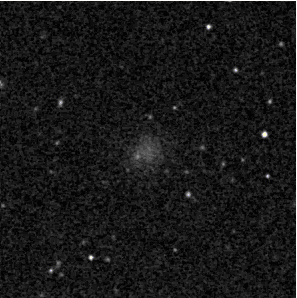
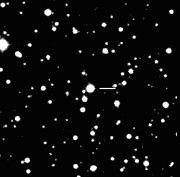
Fig. 7 - Magnitude (Bmag) and sizes: among
the faintest objects is the dwarf galaxy IC 4107 (left), discovered by Wolf, in
Coma Berenices with 18.5mag (the brightest object is the open cluster IC 2602
with 1m.9, the "Southern Pleiades" in Carina). Some
planetaries are very small, e.g. NGC 6833 in Cygnus (right) with only 1"
in diameter (largest object: NGC 292, the Small Magellanic Cloud, with 319' x
205').
The field Type (see Tab. 4)
corresponds to the status and gives further informations. The most complex type
information is given for galaxies (e.g. the Hubble type), mainly adapted from
UGC, ESO and PGC or detemined by own estimation. Generally types differ between
various sources. There is a special type for ring galaxies, following Thompson
[30]. Types for open clusters are included according to Trümpler's
classification. For globular clusters the concentration class (I...XII) is
given.
Tab. 4 -
Abbreviations used in the field type
|
Type |
Explanation |
|
*, *2,..,*Grp |
Star, double star,..,star group
(asterism) |
|
C, D, E, I, P, S |
Galaxy: compact, dwarf,
elliptical, irregular, peculiar, spiral (d=dwarf, B=bar, R=ring , M=mixed);
other letters: from Hubble type or its extensions |
|
R.., PRG |
Ring galaxy (see [30]), Polar ring
galaxy |
|
GxyP |
Part of galaxy (e.g. bright HII
region) |
|
OCL |
Open cluster (if no Trümpler
class is available) |
|
GCL |
Globular cluster (if no
concentration class is available) |
|
DN, EN, RN, PN |
Nebula: dark, emission,
reflection, planetary |
|
SNR |
Supernova remnant |
|
NF |
Not found |
3.6 Identifications and remarks
The fields ID1, ID2
and ID3 contain cross identifications. If the space is not
sufficient, the field Remarks contains additional identifications or a second
line (indicated by X=2) is used. The PGC-number is listed in the field PGC
(LEDA-numbers are listed as PGC-numbers; numbers > 73197).
All abbreviations are
explained in Tab. 5 (see [13] for more details). For the 14002 entries 39096
different identifications are given, coming from 82 catalogues. From these one
can see, to which classes the object belongs (e.g. cluster membership,
morphology, spectral properties). Some of the problems resulting from these
identifications were already discussed, other cases are mentioned below.
Some objects have common
names in other catalogues, e.g. galaxies which are members of an interacting
group (ARP 317 contains the galaxies NGC 3623, NGC 3627 and NGC 3628). Vice
versa there are double entries in one catalogue, e.g. NGC 3627 = ARP 16 = ARP
317. The name ARP 16 refers to the fact, that the galaxy itself is peculiar.
The reason why some galaxies have up to three different CGCG-designations, e.g.
NGC 1544 = CGCG 361-11 = CGCG 362-4 = CGCG 370-1A (the two polar fields are
designated A and B), is due to overlapping Palomar Sky Survey fields inspected
individually by Zwicky.
Another example is the
galaxy IC1502 = UGC 12105 = UGC 12706 = MCG 12-1-1 = MCG 13-1-2 = CGCG 344-3 =
CGCG 359-5 in Cepheus. The object lies on the edge of two MCG-declination zones
(at Decl = +75°) and in two different Zwicky-fields, so
Vorontsov-Velyaminov and Zwicky included it twice in their catalogues. The
double entry in the UGC is probably due to a writing error. UGC 12105 has Rect
= 22 34.1 (there is no galaxy at that position) and UGC 12706 (the real
IC 1502) has Rect = 23 34.1. UGC 12105 ought to be omitted, but is included
here to clarify the situation.
Tab. 5 - Abbreviations from 82 catalogues
used in the fields ID1 to ID11. NGC and IC are not included; PGC (LEDA) is
included for completeness. N counts the total occurances in both
catalogues (if N=1 the object is given).
|
ID |
Explanation |
N |
|
A |
Anonymous galaxy form RC2 [9] |
21 |
|
Abell |
Planetary nebula |
4 |
|
AM |
Arp & Madore (southern
peculiar galaxy) |
782 |
|
ARAK |
Arakelian (galaxy) |
200 |
|
ARP |
Atlas of Peculiar Galaxies [2] |
217 |
|
BCL |
Boulesteix cluster (HII region in
M33) |
7 |
|
Berkeley |
Open cluster |
2 |
|
Bigourdan |
Non-stellar object; Bigourdan 298
= NGC 4411-2 |
1 |
|
Bochum |
Open cluster; Bochum 4 = NGC 2409 |
1 |
|
3C |
Third Cambridge Catalogue of Radio
Sources |
22 |
|
CED |
Cederblad (diffuse galactic
nebula) |
70 |
|
CGCG |
Zwicky's Catalogue of Galaxies and
of Clusters of Galaxies [34]; format: first number = field, second number =
galaxy in field |
6129 |
|
CGMW |
Catalogue of Galaxies Behind the
Milky Way |
14 |
|
COU |
Coutès (Halpha emission
nebula) |
2 |
|
DCL |
Dickens, Currie, Lucey (galaxy in
centaurus custer) |
69 |
|
DDO |
David Dunlop Observatory (dwarf
galaxy) |
32 |
|
DFOT |
Doi, Fugugita, Okamura, Tarusawa
(galaxy in Coma cluster) |
9 |
|
DG |
Dorschner & Görtler
(reflection nebula) |
10 |
|
Djorgovsky |
Globular cluster; Djorgovsky 3 =
NGC 6540 |
1 |
|
DRCG |
Dressler Cluster of Galaxies
(galaxis in different clusters) |
260 |
|
ESO |
ESO/Uppsala Survey of the ESO(B)-Atlas [19]; format: first number = field, second
number = object in field. If the format contains no letters, the object is a
galaxy, otherwise letters are used for special types: RN=reflection nebula
(e.g. ESO 123-RN7), SC=star cluster, EN=emission nebula, PN=planetary nebula,
*N=star(s) in nebula, N*=nebula and star |
3029 |
|
FAIR |
Fairall (compact and bright
nucleus galaxy) |
114 |
|
Fath |
Nebula; Fath 703 = NGC 5892 |
1 |
|
FCC |
Fornax Cluster Catalogue |
42 |
|
FGC |
Flat Galaxy Catalogue (the
extension ist FGCE; the addendum is refered by a following 'A') [17] |
122 |
|
GCL |
Globular Cluster; from the
Catalogue of Star Clusters and Associations |
106 |
|
HARO |
Galaxy with UV excess |
15 |
|
HCG |
Hickson compact group of galaxies |
130 |
|
Henize |
Planetary nebula; Henize 959 = NGC
5408 |
1 |
|
Holmberg |
Dwarf galaxy; Holmberg VI = NGC
1325A |
1 |
|
IRAS |
IRAS catalogue of infrared sources |
3391 |
|
J |
Jonkheere (planetary nebula); J
475 = NGC 6741 |
1 |
|
KARA |
Karachentseva (isolated galaxy) |
229 |
|
KAZ |
Kazayan (emission line galaxy) |
83 |
|
KCPG |
Karachentsev isolated pair of
galaxies |
505 |
|
KDWG |
Karachentsev dwarf galaxy |
3 |
|
Keeler |
Galaxy; Keeler 690 = NGC 5866A |
1 |
|
KUG |
Kiso UV galaxy |
672 |
|
LBN |
Lynds Bright Nebula (emission
nebula) |
101 |
|
LDN |
Lynds Dark Nebula; LDN 1653 = NGC
2313 |
1 |
|
LT |
L. Thompson [30] (ring galaxy) |
2 |
|
Lund |
Open cluster; Lud 1182 = NGC 2175S |
1 |
|
M |
Messier; M 110 = NGC 205 is
included, M 40 and M 45 are not; all other , except M 24 = IC 4715 and M 25 =
IC 4725, are in the NGC |
108 |
|
MCG |
Morphological Catalogue of
Galaxies [33]; first number = declination zone (+15 to -6, "+" sign
is omitted), second number = field in zone (by right ascension), third number
= galaxy in field. |
7624 |
|
Mel |
Melotte (open cluster); Mel 15 =
IC 1805 |
1 |
|
Min |
Minkowski (planetary nebula); Min
2-57 = NGC 896 |
1 |
|
MK |
Markarian (galaxy with UV
continuum) |
277 |
|
New |
Galaxy (Shapley-Ames) |
2 |
|
NPM1G |
Lick Northern Proper Motion Survey
Galaxy Catalogue [18]; Format: declination zone (°) + number |
1705 |
|
OCL |
Open Cluster; from the Catalogue
of Star Clusters and Associations |
382 |
|
Pal |
Palomar (gobular cluster) |
2 |
|
PGC (LEDA) |
Catalog of Principal Galaxies
[22]; continued by "Lyon Extragalactic Database" (LEDA) |
10381 |
|
PHL |
Palomar-Haro-Luyten (blue star or
galaxy); PHL 1226 = IC 1746 |
1 |
|
PK |
Perek & Kohoutek (planetary
nebula) [1]; format: galactic coordinates |
134 |
|
PRC |
Polar ring galaxy |
43 |
|
RB |
Rood & Baum (galaxy in Coma
cluster) |
6 |
|
Reinmuth |
Galaxy; Reinmuth 80 = NGC 4517A |
1 |
|
Reiz |
Galaxy (this identification is
given only if no other identification is available) |
35 |
|
Ruprecht |
Open cluster |
2 |
|
SBS |
Second Byurakan Survey (UV excess
objects) |
3 |
|
SG |
Shain & Gaze (emission nebula) |
3 |
|
Sh2 |
Sharpless (emission nebula) |
19 |
|
Shkh |
Shakhbazian (compact galaxy in
compact group) |
2 |
|
SS |
Struve & Straka (galactic
nebula) |
2 |
|
1SZ, 2SZ |
Southern Zwicky compact galaxies
(2 lists) |
6 |
|
Todd |
Todd (galaxy); found during his
„Telescopic Search for the Trans-Neptunian Planet", AN 113,
153 (1885); some new identifications were found by Klaus Wenzel |
22 |
|
TOL |
Tololo (emission line galaxy) |
9 |
|
UGC |
Uppsala General Catalogue of
Galaxies [20] |
4012 |
|
UGCA |
Catalogue of Selected Non-UGC
Galaxies [21] |
170 |
|
UM |
University of Michigan (emission
line galaxy) |
28 |
|
URA |
Uranova (stellar ring); URA 50 =
IC 1311 |
1 |
|
VCC |
Virgo Cluster Catalog (galaxy) |
527 |
|
vdB |
Van den Bergh (reflection nebula); |
4 |
|
vdB-Hagen |
Van den Bergh-Hagen (open cluster) |
2 |
|
VMT |
Van den Bergh, Marschner, Terzian
(supernova remnant); VMT 9 = IC 443 |
1 |
|
VV |
Vorontsov-Velyaminov (interacting
galaxy) [33] |
322 |
|
WAS |
Wasilewski (emission line galaxy) |
17 |
|
Westerlund |
Open cluster; Westerlund 2 = NGC
3247 |
1 |
|
Z |
Galaxy listed in the Catalogue of
Selected Compact Galaxies and of Post-Eruptive Galaxies [35] only by
1950-coordinates, which are appended. |
22 |
|
ZH |
Zwicky-Humason (galaxy in Abell
194); ZH 32 = IC 1693 |
1 |
|
1ZW..7ZW |
Catalogue of Selected Compact
Galaxies and of Post-Eruptive Galaxies [35], based on 7 lists |
183 |
|
8ZW |
Eighth List of Compact Galaxies
[36] |
28 |
|
Sum |
|
42494 |
Some objects are
misclassified due to their catalogue membership. The planetary nebula IC 3568
is listed in the Uppsala General Catalogue of Galaxies (UGC 7731 = PGC 41662).
Visually it is difficult to decide, if the object is a compact galaxy (a
typical example is Abell 76) or a small planetary nebula with high surface
brightness, e.g. NGC 2242, which was listed by Zwicky as a galaxy (CGCG 205-5).
All three examples are shown in Fig. 8 below.
|
|
|
|
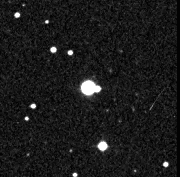
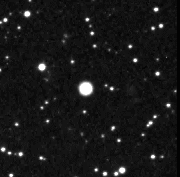
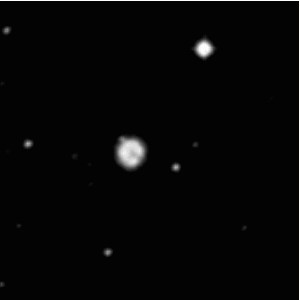
Fig. 8 - Classification problems. Left: IC 3568 = UGC 7731 (planetary
in Camelopardalis), center: NGC 2242 = CGCG 205-5 (planetary in Auriga), right:
Abell 76 (compact galaxy in Aquarius).
The field Remarks
contains additional identifications and information. In case of a planetary
nebula the magnitude of the central star (if known) is given [1]. The field
presents also all known individual names for single or multiple objects
(see also [16]). In Tab. 6 these names are listed, together with the
corresponding object(s). In one case I have created a new name: IC 5173, which
I named "Southern Integral-sign", as it looks like the northern
"Integral-sign", UGC 3697 (Fig. 9). Unlike UGC 3697, which is a
warped galaxy, IC 5173 is a double galaxy (AM 2210-693). Tidal interaction
disturbes the larger (left) one. The smaller component is called IC 5173A = ESO
76-IG8A.
|
|
|
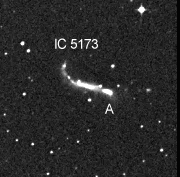
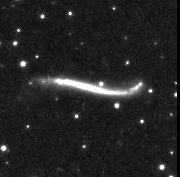
Fig. 9 - The Southern and Northern
Integral-signs: IC 5173 = AM 2210-693 in Indus (left) and UGC 3697 in
Camelopardalis (see explanation above).
Tab. 6 - List of names used in the
catalogues (field Remarks)
|
Name |
Identification |
|
47 Tucanae |
NGC 104 |
|
Ambartsumian's Knot |
30" s of NGC 3561 |
|
Andromeda Nebula |
NGC 224 = M 31 |
|
Antennae |
NGC 4038, NGC 4039 |
|
Atoms For Peace Galaxy |
NGC 7252 |
|
Barnard's Galaxy |
NGC 6822 = IC 4895 |
|
Barnard's Merope Nebula |
IC 349 |
|
Baxendell's Nebula |
NGC 7088 |
|
Bear Claw/Paw Nebula |
NGC 2537 |
|
Beehive Cluster |
NGC 2632 = M 44 |
|
Black Eye Galaxy |
NGC 4826 = M 64 |
|
Blinking Planetary |
NGC 6826 |
|
Blue Flash Nebula |
NGC 6905 |
|
Blue Planetary |
NGC 3918 |
|
Blue Snowball |
NGC 7662 |
|
Bode's Nebulae |
NGC 3031 = M 81, NGC 3034 = M 82 |
|
Box Nebula |
NGC 6309 |
|
Bubble Nebula |
NGC 7635 |
|
Bug Nebula |
NGC 6302 |
|
Butterfly Nebula |
IC 2220 |
|
Butterly Cluster |
NGC 6405 = M 6 |
|
California Nebula |
NGC 1499 |
|
Carafe Group |
NGC 1595, NGC 1598 with ESO
202-G23 ("carafe") |
|
Cat Eye Nebula |
NGC 6543 |
|
Centaurus A |
NGC 5128 |
|
Cetus A |
NGC 1068 |
|
Chi Persei |
NGC 869, NGC 884 |
|
Christmas Tree Cluster |
NGC 2264 |
|
Cocoon Nebula |
IC 5146 |
|
Coddington Nebula |
IC 2574 |
|
Copeland Septet |
NGC 3745, NGC 3746, NGC 3748, NGC
3750, NGC 3751, NGC 3753, NGC 3754 |
|
Crab Nebula |
NGC 1952 = M 1 |
|
Crescent Nebula |
NGC 6888 |
|
Double Cluster |
NGC 869, NGC 884 |
|
Dumbbell Nebula |
NGC 6853 = M 27 |
|
Eagle Nebula |
IC 4703 (in M 16) |
|
Eight-burst Planetary |
NGC 3132 |
|
Epsilon Orionis Nebula |
NGC 1990 |
|
Eskimo Nebula |
NGC 2392 |
|
Eta Carinae Nebula |
NGC 3372 |
|
Flame Nebula |
NGC 2024 |
|
Flaming Star Nebula |
IC 405 |
|
Fornax A |
NGC 1316 |
|
Gamma Cas Nebula |
IC 59, IC 63 |
|
Gamma Cyg Nebula |
IC 1318 |
|
Gem Cluster |
NGC 3293 |
|
Ghost of Jupiter |
NGC 3242 |
|
Grus Quartet |
NGC 7552, NGC 7582, NGC 7590, NGC
7599 |
|
Helix Galaxy |
NGC 2685 |
|
Helix Nebula |
NGC 7293 |
|
Hercules Cluster |
NGC 6205 = M 13 |
|
Herschel's Ray |
NGC 2736 |
|
Hind's Variable Nebula |
NGC 1555 |
|
Horsehead Nebula |
IC 434 |
|
Hubble's Variable Nebula |
NGC 2261 |
|
Intergalactic Wanderer |
NGC 2419 |
|
Jewel Box |
NGC 4755 |
|
Kappa Crucis Cluster |
NGC 4755 |
|
Keenan's System |
NGC 5216, NGC 5218 |
|
Kidney Bean Galaxy |
NGC 4774 |
|
Lagoon Nebula |
NGC 6523 = M 8 |
|
Little Dumbbell |
NGC 650/51 = M 76 |
|
Little Gem |
NGC 6818 |
|
Maia Nebula |
NGC 1432 |
|
Markarian Chain |
NGC 4374, NGC 4406, NGC 4435, NGC
4438, NGC 4458, NGC 4461, NGC 4473, NGC 4477 |
|
Miniature Spiral |
NGC 3928 |
|
Merope Nebula |
NGC 1435 |
|
Mirach's Ghost |
NGC 404 |
|
Nubecula Minor |
NGC 292 = SMC |
|
North America Nebula |
NGC 7000 |
|
Omega Centauri |
NGC 5139 |
|
Omega Nebula |
NGC 6618 = M 17 |
|
Omikron Velorum Custer |
IC 2391 |
|
Orion Nebula |
NGC 1976 = M 42 |
|
Owl Nebula |
NGC 3587 = M 97 |
|
Papillon |
IC 708 |
|
Pelican Nebula |
IC 5067, IC 5070 |
|
Perseus A |
NGC 1275 |
|
Pinwheel Galaxy |
NGC 5457 = M 101 |
|
Polarissima Australis |
NGC 2573 |
|
Polarissima Borealis |
NGC 3172 |
|
Praesepe |
NGC 2632 = M 44 |
|
Ptolemy's Cluster |
NGC 6475 |
|
Rho Ophiuchi Nebula |
IC 4604 |
|
Ring Nebula |
NGC 6720 = M 57 |
|
Running Chicken Nebula |
IC 2944 |
|
Rosette Nebula |
NGC 2237, NGC 2238, NGC 2246
(around NGC 2244 = NGC 2239) |
|
Sagittarius Star Cloud |
IC 4715 = M 24 |
|
Saturn Nebula |
NGC 7009 |
|
Sculptor Galaxy |
NGC 253 |
|
Seyfert Sextet |
NGC 6027 (A-E) |
|
Siamese Twins |
NGC 4567, NGC 4568 |
|
Silver Dollar |
NGC 253 |
|
Small Magellanic Cloud (SMC) |
NGC 292 |
|
Sombrero Galaxy |
NGC 4594 = M 104 |
|
Southern Integral-sign |
IC 5173 |
|
Southern Pleiades |
IC 2602 |
|
Spindle Galaxy |
NGC 3115 |
|
Starqueen Nebula |
IC 4703 (in M 16) |
|
Stephan's Quintet |
NGC 7317, NGC 7318A, NGC 7318B,
NGC 7319, NGC 7320 |
|
Struve's Lost Nebula |
NGC 1554 |
|
Sunflower Galaxy |
NGC 5055 = M 63 |
|
Tarantula Nebula |
NGC 2070 = 30 Dor |
|
Taurus A |
NGC 1952 = M 1 |
|
The Box |
NGC 4169, NGC 4173, NGC 4174, NGC
4175 |
|
The Eyes |
NGC 4435, NGC 4438 |
|
The Mice |
NGC 4676A, NGC 4676B |
|
Toby Jug Nebula |
IC 2220 |
|
Triangulum Galaxy |
NGC 598 = M 33 |
|
Trifid Nebula |
NGC 6514 = M 20 |
|
Ursa Major A |
NGC 3034 = M 82 |
|
Veil Nebula |
NGC 6960, NGC 6992, NGC 6995 |
|
Virgo A |
NGC 4486 = M 87 |
|
Whirlpool Galaxy |
NGC 5194 = M 51 |
|
Wild Duck Cluster |
NGC 6705 = M 11 |
|
Witch Head Nebula |
IC 2118 |
|
Zwicky's Triplet |
IC 3481, IC 3481A, IC 3483 |
[1] Acker, A., et al.,
Strasbourg-ESO Catalogue of Planetary Nebulae, München 1990; see also:
Catalogue of the Central Stars of True and Possible Planetary Nebulae,
Strasbourg 1982
[2] Arp, H. C., Atlas of
Peculiar Galaxies, Pasadena 1966 (see also: Astrophys.
J. Suppl. 14, 1 (1966))
[3] Carlson, D., Some
Corrections to Dreyer's Catalogues of Nebulae and Clusters, Astrophys. J. 91
350 (1940)
[4] Corwin, H. G., de
Vaucouleurs, A., de Vaucouleurs, G., Southern Galaxy Catalogue, Austin 1985
[5] Corwin, H. G., et al.,
Accurate Positions for MCG Galaxies, PASP 110, 779 (1998)
[6] Corwin, H. G., Precice
Position List, NGC/IC Project, Jan. 2011
[7] Corwin, H. G., NGC/IC
Puzzle Solutions, NGC/IC Project, Jan. 2011
[8] Cragin, M., Bonanno,
E., Deep Sky Field Guide, Willmann Bell 2001
[9] de Vaucouleurs, G., de
Vaucouleurs, A., Corwin, H.C., Second Reference Catalogue of Bright Galaxies,
New York 1991
[10] de Vaucouleurs, G., et
al., Third Reference Catalogue of Bright Galaxies, New York 1991
[11] Dixon, R. S.,
Sonneborn, G., A Master List of Nonstellar Optical Astronomical Objects, Ohio
State Univ. Press 1980
[12] Dreyer, J. L. E., New
General Catalogue, Index Catalogue, Second Index Catalogue, London 1962
[13] Lortet, M.-C., Borde,
S., Ochsenbein, F., Astron. Astrophys. Suppl. 107, 193 (1994)
[14] Gottlieb, S.,
Corrections to the RNGC, NGC/IC Project 1998-2004
[15] Harris W. E., Astron.
J. 112, 1487 (1996)
[16] Hirshfeld, A., Sinnott,
R. W., Sky Catalogue 2000.0, Vol. 2, Cambridge, Mass. 1985
[17]
Karachentsev I. D. et al., Astron. Nachr. 314, 97 (1993)
[18] Klemola A. R., Hanson
R. B., Jones B. F., Astron. J. 94, 501 (1987)
[19] Lauberts, A., The
ESO/Uppsala Survey of the ESO(B)-Atlas, München
1982
[20] Nilson, P., Uppsala
General Catalogue of Galaxies, Uppsala 1973
[21] Nilson, P., Catalogue
of Selected Non-UGC Galaxies, Uppsala 1974
[22] Paturel, G., et al.,
Catalogue of Principal Galaxies, LEDA 2003 (http://leda.univ-lyon1.fr)
[23] RealSky, Astronomical
Society of the Pacific, San Francisco, 1996, 1997
[24] The Digized Sky Survey
(102 CD-ROM version), Space Telescope Science Institute, 1993
[25] Reinmuth, K., Die
Herschel-Nebel, Veröff. Sternwarte Heidelberg, Bd. 9, 1926
[26] Sandage, A., Bedke,
J., The Carnegie Atlas of Galaxies, Washington D.C.
1994
[27] Sinnott, R. W., NGC
2000.0, Cambridge University Press, Cambridge, Mass. 1988
[28] Skiff, B., Precise
Positions for the NGC/IC Planetary Nebulae, Flagstaff, Arizona 1996
[29] Sulentic, J. W.,
Tifft, W. G., Revised New General Catalogue of Nonstellar Astronomical Objects,
Tuscon 1977
[30] Thompson, L. A ., Astrophys. J. 211, 684 (1977)
[31] Thomson, M. J.,
Identity Survey of IC Galaxies, NGC/IC Project, 2006
[32] Vorontsov-Velyaminov,
B. A., Atlas and Catalogue of Interacting Galaxies, Part I, Moscow 1959 (for
Part II see: Astron. Astrophys. Suppl. 28, 1 (1977))
[33] Vorontsov-Velyaminov,
B. A., Arkhipova, V. P., Morphological Catalogue of Galaxies, Vol. I-IV, Moskow
1962-1968; see also: Kogoshvili, N. G., Merged Catalogue of Galaxies, Bul.
Abastumani Astr. Obs. 46, 133 (1975)
[34] Zwicky, F., et al.,
Catalogue of Galaxies and of Clusters of Galaxies, Vol. 1-6, Pasadena 1963-68
[35] Zwicky, F., Zwicky, M.
A., Catalogue of Selected Compact Galaxies and of Post-Eruptive Galaxies,
Zürich 1971
[36] Zwicky, F., Sargent,
W. L. W., Kowal C. T., Eighth List of Compact Galaxies, Astron. J. 80,
545 (1975)